Despite following a disciplined routine—training rigorously and optimizing sleep environment—his deep sleep metrics remained stagnant until he used Get Blue.
MEMBER STORY
MALE | 46 YEARS OLD
Before using Get Blue, a member was frustrated with his inability to get deep sleep. He bought an immersive sleep system expecting the cooling technology to raise his deep sleep. Two weeks later the improvement was minimal. He wore blue light blockers, stopped eating two hours before bed and stopped drinking water one hour before. His deep sleep was still capped at 50 minutes.
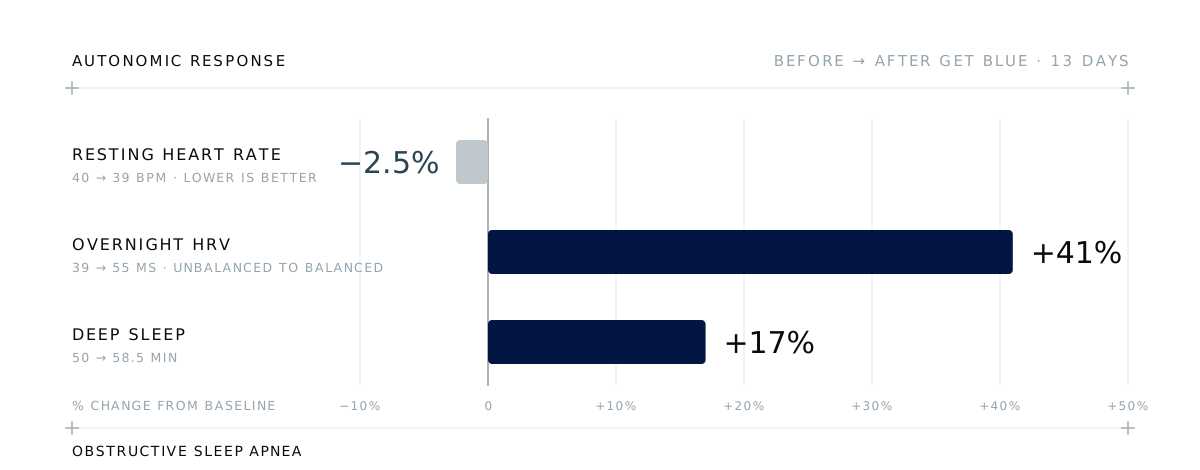
He then started using Get Blue to read his wearable data, sleep system data and self-reported lifestyle habits together. His aerobic training was consistent and his resting heart rate had fallen to 40, as a result. However, his overnight HRV sat at 39 and was frequently unbalanced. His fitness was improving, but his overnight recovery was not.
Interpreting this discrepancy as an oxygen concern rather than overtraining or poor sleep hygiene, Get Blue advised him to consult his physician for a sleep evaluation. This led to a diagnosis of obstructive sleep apnea. After 13 nights using a CPAP machine, his HRV rose to 55, staying balanced, and his deep sleep increased by 17%.
THE SCIENCE
SCIENTIFIC FOUNDATION & PHYSIOLOGICAL MECHANISMS
To maintain rigorous standards, Get Blue relies strictly on controlled physiological research—rather than observational or single-arm studies—when translating diagnostic signals into actionable recommendations. Controlled studies demonstrate that recurrent upper airway blockages during sleep directly trigger persistent sympathetic nerve activity, an effect that subsides once the obstruction is treated.
UNDERSTANDING AUTONOMIC DIVERGENCE
While aerobic conditioning typically decreases resting heart rate while simultaneously elevating heart rate variability (HRV), a discrepancy between the two usually points to factors beyond exercise volume. For instance, combining a low resting heart rate of 40 with a low overnight HRV of 39 signals an abnormal autonomic response that warrants further medical investigation.
INTEGRATING MULTI-SENSOR & BEHAVIORAL DATA
Get Blue synthesizes multiple data streams concurrently—including wearable telemetry, user-reported habits, and smart bed metrics. In this instance, because the sleep system had already optimized position and temperature relative to sleep stages, environmental and positional variables were ruled out, isolating airway mechanics as the primary underlying cause.
CLINICAL SIGNIFICANCE & LONG-TERM HEALTH RISKS
Unexplained autonomic divergence is a clinical priority, not a minor variable to optimize around. Extensive prospective cohort research links untreated obstructive sleep apnea to elevated cardiovascular risk and increased all-cause mortality, with risk scaling alongside severity. Although these observational findings establish correlation rather than clinical proof that treatment reduces cardiovascular events, they highlight that undiagnosed sleep apnea carries a substantial long-term risk profile. Consequently, the appropriate resolution was medical evaluation by a physician, not a routine lifestyle protocol.
SOURCE
A Protocol Built Around Your Biology.
Get Blue reads your labs, wearables and habits together, matches the intervention the evidence supports, and shows what is working for you.
Individual results. Aged garlic extract is a dietary supplement and is not a treatment for any medical condition. Get Blue protocols are not a substitute for care from your physician. Get Blue recommends specific supplement doses within the labeled range, personalized to the member's own data, and adjusts them as retests come in.